TALLYHO BUTTERFLY FARM
Welcome to our website! *CURRENTLY, OUR FARM IS NOT OPEN FOR VISITIORS*
WE WILL BE OUT OF OFFICE FROM
8/14 THROUGH 8/19
IF YOU ORDER ANYTHING
DO NOT EXPECT IT TO BE SHIPPED FROM THOSE DAYS !!!!
Message us: 267-410-2619
Email: tallyhobutterflies@gmail.com
WE ONLY SELL EGGS AND CHRYSALIDES!
We are not open for any appointments, visits, or in-person orders.


If you see a Zebra Longwing (latin name Heliconius charithonius) in your Pennsylvania yard, you might as well go buy a lottery ticket. This is because there have been zero sightings of Zebra Longwings in Pennsylvania, and their native range only goes up to South Carolina and some parts of southern California. In some places, like Kansas, Oklahoma, North Carolina, or Tennessee, Zebra Longwings can be a time-to-time sighting in the height of the summer, when the temperatures and humidity match their subtropic/tropical climate necessities. In places such as Florida, Louisiana, and southern Texas, where it usually never goes below freezing temperatures at all, they fly all year round. But in northern states that they stray to, they only fly from July-September.

The Zebra Longwing's food plant that the caterpillars will feed on is passionvine (Passiflora spp.) The only passionvine that they will not eat are the ones with red flowers, which have too much toxin for them and will kill them. This specific passionvine in the photo is Maypop passionvine (Passiflora incarnata), which is a Pennsylvania native and a perennial.

Zebra Longwings lay their eggs on tender shoots of passionvine plants in clusters of 5-20.

Day 1, 5/19/23, 8:02 AM. Temp: 68F. These Zebra Longwing eggs were laid on the new growth of a Passionvine plant. This begins day 1 as an egg.

Day 3, 5/22/23, 10:05 AM. Temp: 72F. The eggs have now hatched, beginning Day 1 as a caterpillar!

Day 5, 5/24/23, 11:42 AM. Temp: 74F. The caterpillar has grown a little since the last check-in, it should be molting into the 2nd instar soon.

Day 7, 5/26/23, 2:34 PM. Temp: 80F. The caterpillar is now in the 2nd instar, almost about to molt into it's 3rd!

Day 10, 5/29/23, 4:42 PM. Temp: 79F. The caterpillar is growing super fast -- it's already close to molting into it's 4th instar!

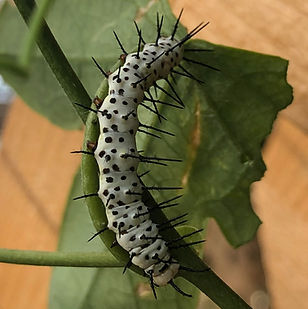
Day 12, 5/31/23, 6:08 PM. Temp: 80F. The caterpillar is now in it's 4th instar. You can clearly see the famous colorings of a Zebra Longwing caterpillar now.
.jpg)
Day 14, 6/2/23, 6:34 PM. Temp: 81F. The caterpillar is in it's 5th, and final instar. In a few days, it should start j-hanging and make a chrysalis.

Day 16, 6/4/23, 8:24 PM. Temp: 78F. The caterpillar has been j-hanging for around a day, and is about to form a chrysalis.

Day 16, 6/4/23, 8:24 PM. Temp: 78F. The caterpillar has begun the process of changing into a chrysalis, shedding its skin and revealing the chrysalis inside.

Day 16, 6/4/23, 8:24 PM. Temp: 78F. The chrysalis is around halfway up the caterpillar.

Day 16, 6/4/23, 8:25 PM. Temp: 78F. The chrysalis is around 3 quarters of the way up the caterpillar.

Day 16, 6/4/23, 8:25 PM. Temp: 78F. The caterpillar has fully shed its skin.

Day 22, 6/10/23, 2:08 PM. Temp: 78F. The caterpillar has fully shed its skin.

Day 26, 6/14/23, 11:05 PM. Temp: 72F. The butterfly is visible through the chrysalis, meaning that it should emerge by tomorrow morning.

Day 27, 6/15/23, 9:45 AM. Temp: 81F. The Zebra Longwing butterfly has emerged, and in an hour or two, it is ready to fly! Zebra Longwing butterflies are monomorphic, which means that the males and females have no differences between eachother.

Day 27, 6/15/23, 1:05 PM. Temp: 84F. The Zebra Longwing is ready to fly!

These 2 Zebra Longwings are mating, restarting the cycle over again. Zebra Longwings can live up to 2-4 months, and lay hundreds of eggs during this time. The reason why they can live for so long (along with Julia Longwings) is that unlike most butterflies, Zebras and Julias drink pollen along with nectar, which gives them more protein, allowing them to live longer than most butterflies.