TALLYHO BUTTERFLY FARM
Welcome to our website! *CURRENTLY, OUR FARM IS NOT OPEN FOR VISITIORS*
WE WILL BE OUT OF OFFICE FROM
8/14 THROUGH 8/19
IF YOU ORDER ANYTHING
DO NOT EXPECT IT TO BE SHIPPED FROM THOSE DAYS !!!!
Message us: 267-410-2619
Email: tallyhobutterflies@gmail.com
WE ONLY SELL EGGS AND CHRYSALIDES!
We are not open for any appointments, visits, or in-person orders.


The Gulf Fritillary (latin name Agraulis vanillae) is a rare sight in Northern states such as Pennsylvania, only being spotted a couple times over the last century. Gulf Fritillaries should be considered a stray to Pennsylvania, and have been spotted during the hot summer months when the temperature is the same as their normal habitat in southern states. While Gulf Fritillaries are very rare in Pennsylvania, they are able to be released in the state of PA under USDA guidelines. Although it is allowed, we don't release them since Passionvine doesn't naturally grow in lots of areas in Pennsylvania. Males are a bright orange-ish red color, while females are a darker orangish-tan color. We have found Gulf Fritillaries to be one of the easiest species to breed, and have been able to raise 5-6 generations per season each year.
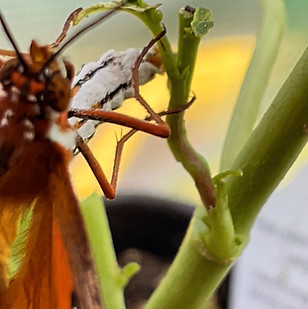
Here is a female Gulf Fritillary laying eggs on a new shoot of a passionvine plant (P. incarnata). This egg will be the start of our documentation of the life cycle of the Gulf Fritillary. One weird habit of the Gulf Fritillary is that they don't always lay their eggs on the host plant, sometimes they lay their eggs near the host plant. I don't really know why they do this, because this just makes it so the Gulf Fritillary caterpillar has to find their hostplant instead of being directly on it when hatching, and the larva don't have that good of eyesight anyway.

Although hard to see, the little yellow dot next to the big gray screw is a Gulf Fritillary egg! It was laid on the main frame of our flight area, right to the left of a passionvine plant.

Day 1, 6/8/24. 4:45 PM. Temp: 81F. This is the first day of the Gulf Fritillary's life cycle. The egg looks similar to a Monarch egg, but instead of being pointed at the top it flattens out and makes the egg look like a miniature corn cob. It usually takes only 2-3 days for a Gulf Fritillary egg to hatch, due to its natural habitat being very warm all year round. If temperatures are above 75F, it shouldn't take long for this little guy to become a caterpillar.

Day 3, 6/11/24. 8:22 AM. Temp: 76F. It has been around 3 days since the last photo was taken, and now you can clearly see the developing caterpillar inside. It should hatch in around 1-2 more days.
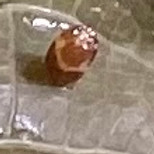
Day 4, 6/12/24. 9:54 AM. Temp: 78F. It has been 4 days since the egg was laid, and now the caterpillar is ready to hatch. It will be hatching any moment.

Day 4, 6/12/24. 11:33 AM. Temp: 80F. The caterpillar has now hatched. The red color it has now is the color it will keep for the rest of the caterpillar stage. It will grow drastically, though.

Day 7, 6/15/24. 10:42 AM. Temp: 81F. The caterpillar is now in the 2nd instar. It now has the famous black spines that it is known for, and a more reddish coloring. While the spines may look intimidating, especially at older stages, they are not venomous or harmful at all. They are only meant to look scary to predators and also to choke birds if they are eaten by them in later stages (since the spines are so big, the caterpillar could get caught in the bird's throat, killing it.)

Day 9, 6/17/24. 2:23 PM. Temp: 84F. The caterpillar is in the 3rd instar, with the spines getting bigger and the caterpillar getting even redder. When the caterpillar gets to older stages, it will have black markings running down its back as well. This caterpillar was photographed under a microscope to show the branching of the spines that normally cannot be seen under the 4th or 5th instar.
.jpeg)
Day 12, 6/20/24. 5:53 PM. Temp: 77F. The caterpillar is now in the 4th instar, being noticeably bigger than the 3rd instar and having the black lines that run down the caterpillars back more visible. Here the caterpillar is photographed next to a Variegated Fritillary, the northern version of the Gulf Fritillary that is native to northern regions of the US but doesn't like to stray too far south. The Variegated Fritillary also eats passion vines, but will also eat violets and other plants.

Day 14, 6/22/24. 9:32 AM. Temp: 75F. The caterpillar is finally in its last instar. It will grow a bit more, but this is the final stage until it goes into the chrysalis. You can clearly see the black lines running down the caterpillar's back, and faintly see the branching on the spines that we saw under the microscope during the 3rd instar.

Day 16, 6/24/24. 1:31 PM. Temp: 84F. The caterpillar is now in the "j-hang" position, where it will hang upside down in a J for around 1-2 days.

Day 18, 6/26/24. 3:44 PM. Temp: 86F. The caterpillar is about to shed its skin and form its chrysalis.

Day 18, 6/26/24. 3:45 PM. Temp: 86F. The caterpillar has just split its skin a few seconds ago, and the chrysalis is showing.

Day 18, 6/26/24. 3:46 PM. Temp: 86F. The chrysalis has fully formed, and all the caterpillar needs to do is shake off the little black spike ball at the top of the chrysalis.

Day 18, 6/26/24. 3:47 PM. Temp: 86F. The caterpillar has shaken off the last of its exoskeleton, and now all it needs is 2 weeks to transform into a butterfly.

Day 25, 7/3/24. 8:44 AM. Temp: 80F. The chrysalis is around 1 week old. The Gulf Fritillary chrysalis disguises itself as a dried up leaf, and the caterpillar also ususally pupates on the undersides of passionvine leaves to protect themselves from predators.

Day 32, 7/10/24. 10:05 PM. Temp: 74F. The chrysalis is about to hatch, shown by the wings being able to be seen through the chrysalis. This butterfly will emerge by the next morning.

Day 33, 7/11/24. 11:02 AM. Temp: 85F. The male Gulf Fritillary butterfly has emerged and is ready to fly.

Day 33, 7/11/24. 11:02 AM. Temp: 85F. The male Gulf Fritillary butterfly has emerged and is ready to fly.